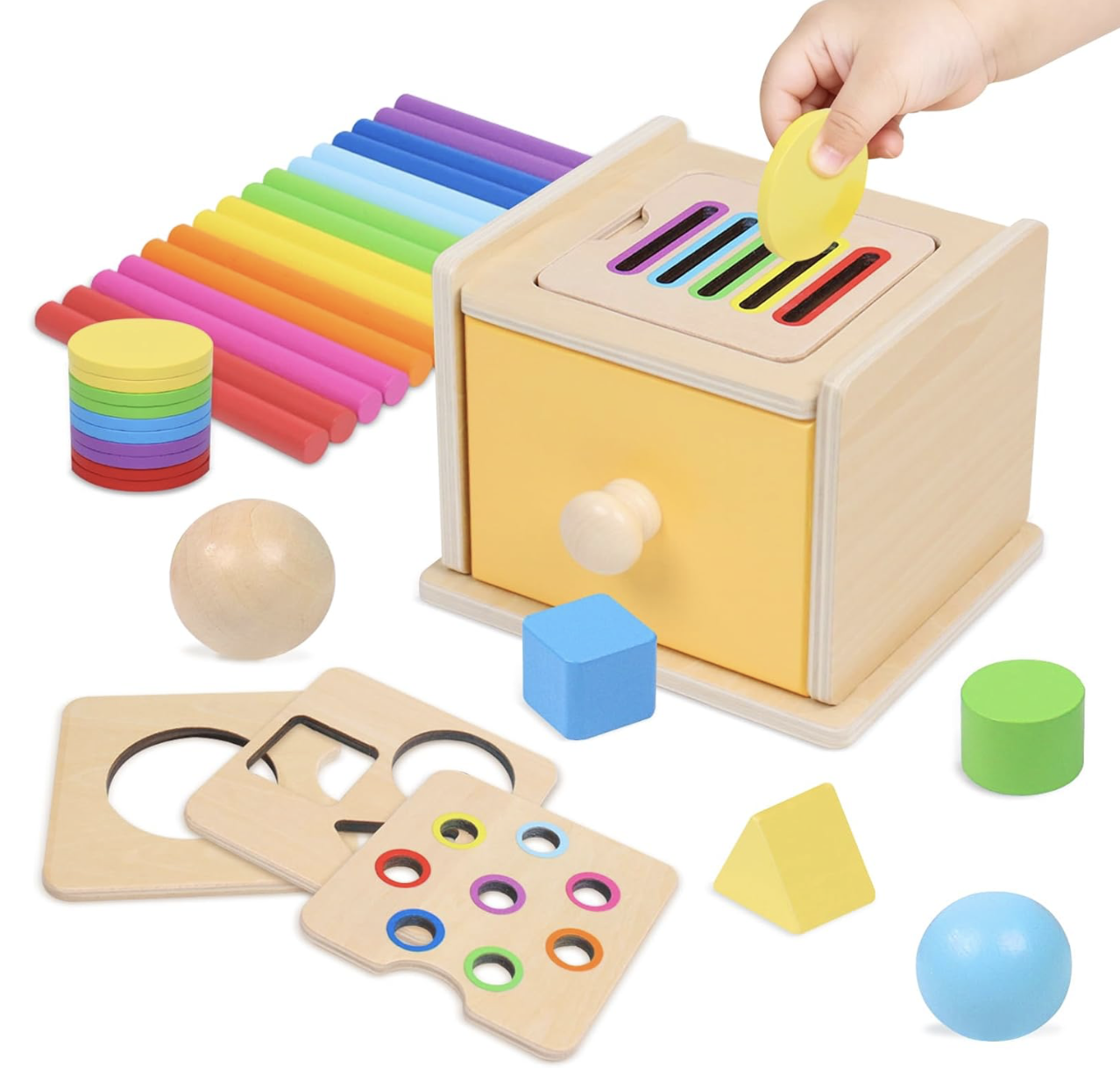
Coin Box, Ball Drop, Color Sorting
Why We Recommend This Toy
This toy combines multiple developmental concepts into one activity set—object permanence, fine motor development, visual problem-solving, shape recognition, and early cognitive flexibility. Because children can interact with the toy in different ways (coin drop, ball drop, shape sorting, and color matching), it grows with developmental progression and supports repeated practice without becoming overly structured.
What This Toy Is Useful For
This toy supports development across multiple areas:
Fine motor skills – build grasp strength, wrist control, hand opening, finger isolation, and controlled release
Early language & speech development – provide opportunities to introduce concepts like colors, shapes, location words (“in,” “out,” “under”), and action words
Cognitive skills – counting, colors, cause-and-effect, learn to test ideas, make corrections, and adjust movements when objects do not fit.
Social skills – turn-taking, shared play, joint attention
Attention & regulation – encourages repeating actions, staying engaged, and working through small challenges
How to Use This Toy by Age
-
At this stage, children are learning cause-and-effect, beginning problem-solving, and understanding that hidden objects still exist.
Ideas to try:
Start with only one activity panel at a time to avoid overwhelming choices.
Demonstrate dropping one ball or coin and immediately opening the drawer together.
Narrate what happens: “It went in… where did it go?”
Practice opening and closing the door independently.
Hold objects partially in the opening and let your child finish pushing.
Play peek-a-boo with pieces (“Where did the ball go?”).
Place only 2–3 objects out at once to encourage focused exploration.
Encourage giving objects to you and taking turns.
Children this age are developing object permanence, simple cause-and-effect understanding, releasing objects intentionally, and beginning to solve one-step problems.
-
Children begin combining motor skills with more intentional thinking and can tolerate greater challenge.
Ideas to try:
Encourage independent retrieval after dropping objects inside.
Match colors when inserting coins.
Introduce shape names while sorting (“circle,” “square”).
Practice one-step directions (“Put the yellow one in”).
Hide a favorite object inside and encourage searching.
Alternate between activities (ball drop → shape sort → coin drop).
Count objects as they go in and come out.
Create simple sorting games (all circles first).
Children at this age are beginning categorization, sustained attention, flexible problem-solving, and improved motor planning.
-
Children become more efficient and can begin using the toy creatively and with more rules.
Ideas to try:
Complete multi-step challenges (“Find the blue coin, put it in, then open the drawer”).
Sort by shape, color, or size before inserting.
Time retrieval games (“Can you find all 5?”).
Create memory games by hiding multiple objects inside.
Introduce pretend play (“Deliver the mail,” “Feed the box”).
Practice counting and comparing quantities.
Ask prediction questions (“Which opening will fit?”).
Encourage your child to explain how they solved problems.
Older toddlers are developing executive functioning, planning, flexible thinking, symbolic play, and more advanced visual-motor integration that supports later preschool learning.