Multi Sensory Shape Sorter
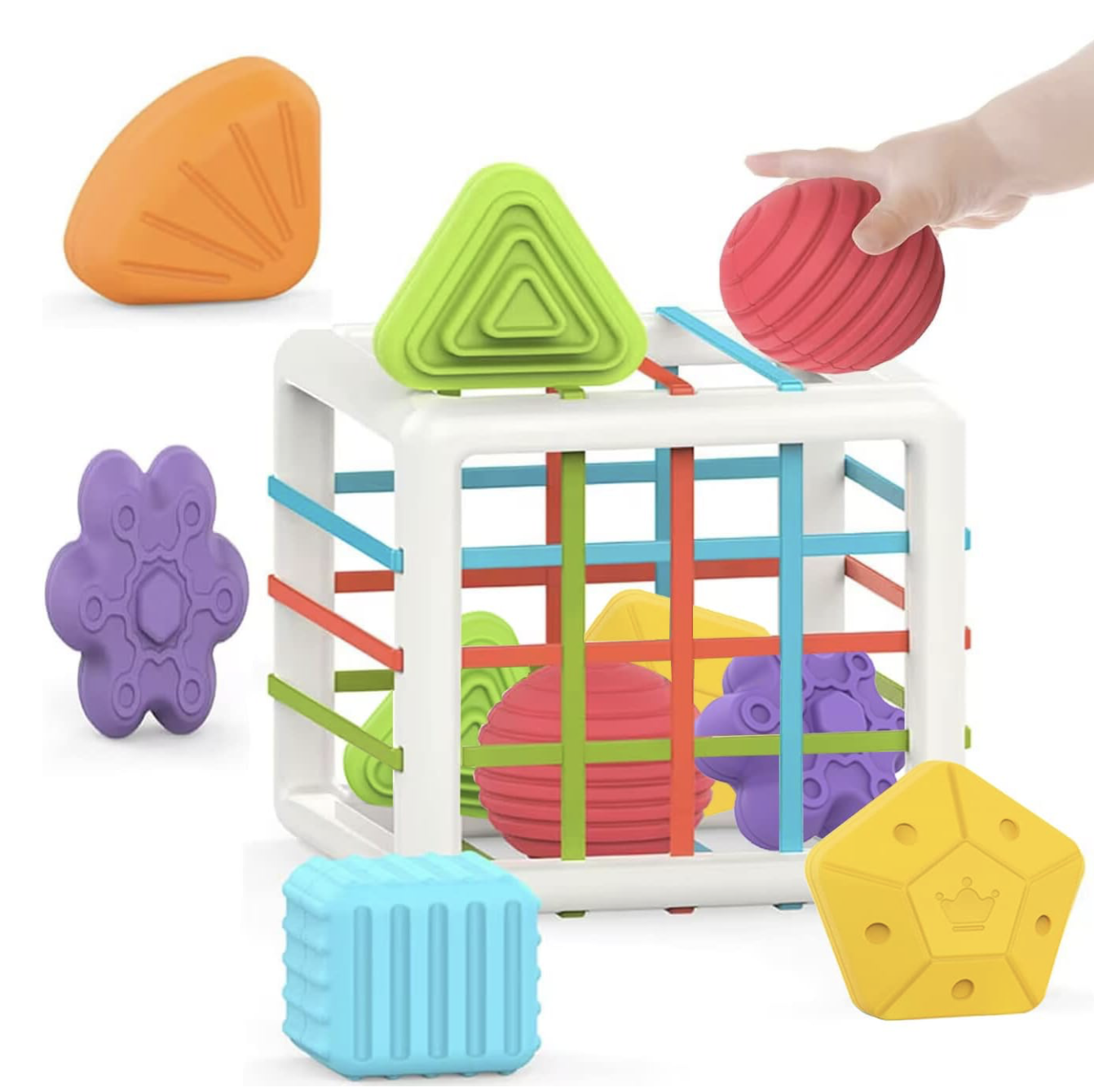
Why We Recommend This Toy
This multi-sensory shape toy encourages problem-solving, fine motor development, hand-eye coordination, and sensory exploration. The textured shapes and elastic-band cube give babies and toddlers a fun way to practice pulling, reaching, grasping, matching, and exploring different shapes and textures.
What This Toy Is Useful For
This toy supports development across multiple areas:
Fine motor skills – grasping, pulling, pushing, and manipulating objects through the elastic bands
Early language & speech development – choices, labeling, and imitation
Cognitive skills – problem solve how to remove and insert shapes through the bands
Social skills – turn-taking, shared play, joint attention
Sensory – textures, colors, and shapes for tactile and visual exploration
How to Use This Toy by Age
-
At this stage, babies learn primarily through sensory exploration and repetitive movement. Keep the cube open and offer one shape at a time rather than expecting shape sorting.
Ideas to try:
Let your baby hold, mouth (if used safely as intended), tap, and transfer shapes between hands.
Place one textured shape nearby during tummy time to encourage reaching and weight shifting.
Gently rub shapes on hands, feet, or cheeks while naming textures (“smooth,” “bumpy,” “lines”).
Roll round shapes across the floor to encourage visual tracking.
Hold a shape partially through the elastic bands and encourage your child to pull it out.
Introduce simple language like “in,” “out,” “push,” “pull,” and color names.
Young infants are building sensory awareness, grasping skills, visual attention, and early cause-and-effect understanding rather than true sorting or matching.
-
Children begin combining movement with problem-solving and can interact more intentionally with the toy.
Ideas to try:
Encourage your child to pull shapes out independently.
Demonstrate putting pieces back through the elastic bands and allow trial and error.
Hide one shape inside and ask, “Can you find it?”
Practice simple directions (“give me the blue one,” “put it in”).
Stack or line up shapes after removing them.
Compare textures (“Which one feels bumpy?”).
Introduce shape and number awareness if the pieces include symbols or numbers.
Turn it into a turn-taking game (“my turn, your turn”).
Children this age are developing fine motor coordination, motor planning, problem-solving, receptive language, and understanding that actions produce predictable outcomes.
-
Toddlers can use the toy in more purposeful and imaginative ways and tolerate longer problem-solving activities.
Ideas to try:
Challenge your child to insert shapes independently through different sides of the cube.
Sort by color, texture, or shape.
Count pieces together and label numbers.
Give two-step directions (“Find the yellow shape and put it inside”).
Create pretend play (“Feed the cube,” “Hide the treasure”).
Time retrieval games (“How many can you pull out?”).
Build patterns (red–blue–red–blue).
Practice turn-taking and requesting with siblings or caregivers.
Toddlers are strengthening executive functioning, early categorization skills, language comprehension, sustained attention, and more advanced fine motor control while beginning to use toys in flexible and imaginative ways.