Sensory Color Shape Sorter
Why We Recommend This Toy
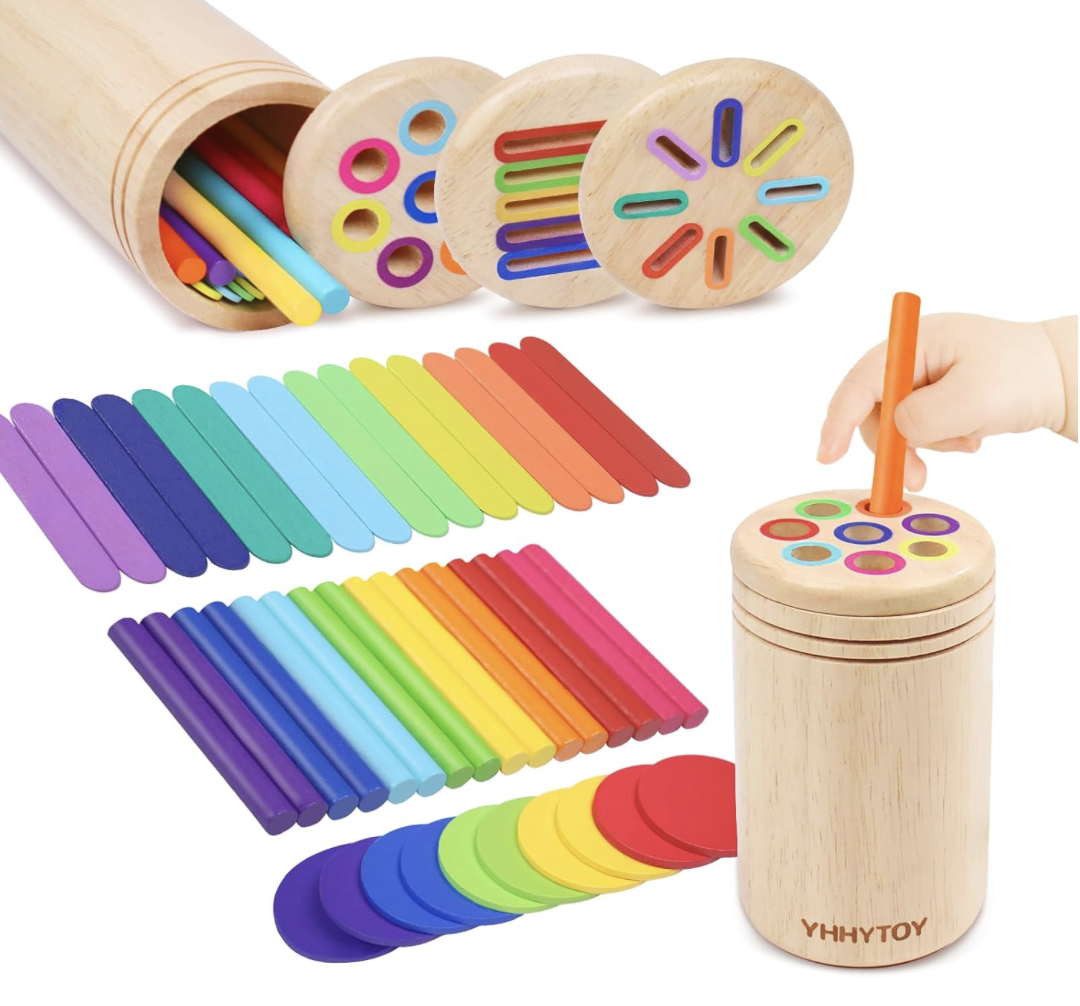
This open-ended fine motor toy supports color recognition, visual discrimination, bilateral coordination, problem-solving, and early pre-academic concepts through hands-on play. Because it includes multiple ways to play (sorting sticks, matching discs, and inserting rods), it can grow with children and be adjusted to different developmental levels.
What This Toy Is Useful For
This toy supports development across multiple areas:
Fine motor skills – Builds grasp strength, finger isolation, wrist stability, and controlled release while inserting and removing pieces
Early language & speech development – Creates opportunities to label colors, describe actions, follow directions, and expand vocabulary
Cognitive skills – Introduces sorting, categorization, sequencing, and early problem-solving
Social skills – Turn-taking, shared play, joint attention
Attention & regulation – Encourages sustained attention, task completion, flexibility, and organizing materials
How to Use This Toy by Age
-
At this stage, children learn best through exploration and simple cause-and-effect activities. Focus less on accuracy and more on interacting with the materials.
Ideas to try:
Dump all the pieces out and let your child explore textures, sizes, and movement.
Practice putting sticks into the container without matching colors.
Drop discs into the opening and dump them back out repeatedly.
Model “in,” “out,” “open,” and “close.”
Offer only 2–3 colors at a time to reduce visual demand.
Encourage handing pieces to you (“give me blue”).
Roll sticks, tap them together, or line them up.
Children this age are developing grasping, releasing, understanding cause-and-effect, following simple directions, and tolerating short structured activities.
-
Children begin intentionally sorting and noticing relationships between objects.
Ideas to try:
Match one color at a time (all reds together).
Sort only discs or only sticks before combining tasks.
Practice placing pieces into matching openings.
Give simple directions (“Find yellow,” “Put in blue”).
Count pieces together (“1, 2, 3”).
Build rows or simple patterns with sticks.
Play “find the missing color.”
Introduce concepts like same/different and big/small.
Children at this age begin categorizing, matching visually, maintaining attention longer, and combining motor skills with simple problem-solving.
-
Children can engage in more structured and challenging activities and begin using the toy in flexible ways.
Ideas to try:
Sort all pieces independently by color.
Complete timed sorting challenges (“Can you finish before the song ends?”).
Create color patterns (red–blue–red–blue).
Count and compare quantities (“Which color has more?”).
Practice one- and two-step directions (“Find green then put it in”).
Hide pieces and create a scavenger hunt.
Use pretend play (“Feed the color machine”).
Introduce early math concepts like grouping and simple addition.
Encourage your child to explain their thinking (“Why did that go there?”).
Older toddlers are developing categorization, sustained attention, flexible thinking, early math readiness, and more precise hand control needed for preschool learning tasks.