Stacking Nesting Cups
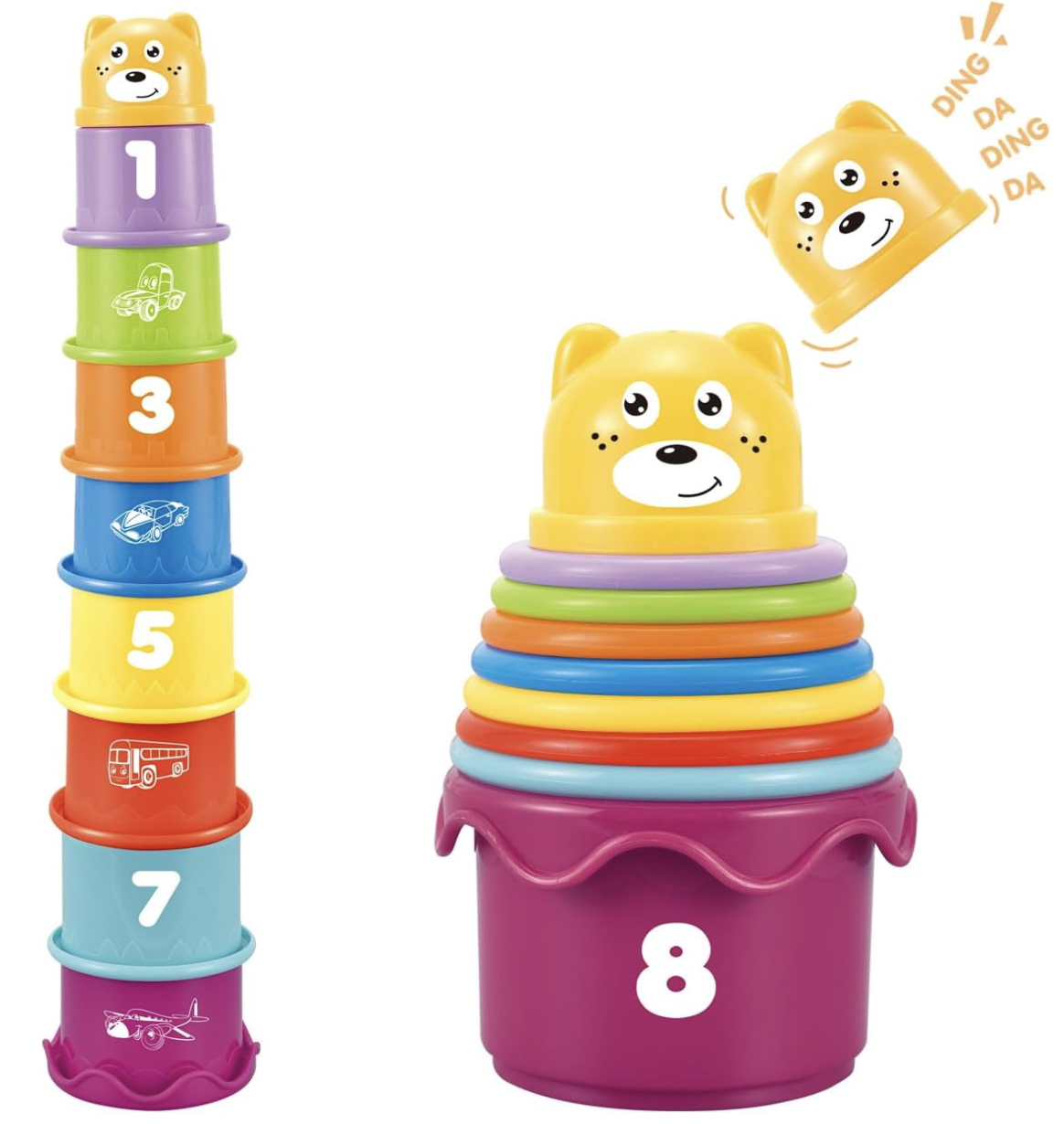
Why We Recommend This Toy
Stacking cups are one of our favorite open-ended developmental toys because they grow with children across multiple stages of development. A simple set of cups can support fine motor skills, visual-spatial learning, early problem-solving, language, early math concepts, and imaginative play—all while remaining easy to adapt to your child’s level.
What This Toy Is Useful For
This toy supports development across multiple areas:
Fine motor skills – build grasping, releasing, bilateral coordination, finger control, and controlled placement
Early language & speech development – provides opportunities to teach colors, numbers, location words, and descriptive language
Cognitive skills – counting, colors, cause-and-effect, experimentation, making mistakes, adjusting, and discovering how objects work together
Social skills – turn-taking, shared play, joint attention
Visual-Spatial Development – encourages understanding concepts like size, order, fit, and spatial relationships
How to Use This Toy by Age
-
At this stage, babies are learning through touching, exploring, and understanding how objects move and feel.
Ideas to try:
Offer 2–3 cups at a time instead of the full stack.
Let your baby bang cups together to explore sound.
Demonstrate putting one cup inside another and dumping them out.
Use cups during tummy time and place one slightly out of reach to encourage reaching.
Hide a small toy under a cup and reveal it dramatically.
Roll cups gently across the floor to encourage visual tracking.
Stack only 2 cups and let your child knock them down.
Introduce simple words like “up,” “down,” “in,” “out,” and color names.
Young infants are developing reaching, grasping, visual attention, cause-and-effect understanding, and beginning object permanence.
-
Children begin intentionally combining objects and experimenting with how things fit together.
Ideas to try:
Encourage nesting cups inside one another independently.
Build short towers and let your child knock them down.
Practice stacking from large to small with support.
Hide objects underneath and encourage searching.
Fill cups with small safe items and dump them out.
Use cups during bath time for pouring and scooping.
Count cups as you stack.
Compare sizes (“big,” “bigger,” “small”).
Practice turn-taking (“my cup, your cup”).
Children this age are strengthening problem-solving, releasing objects intentionally, visual-spatial understanding, and combining actions into purposeful play.
-
Children begin using stacking cups in more flexible, imaginative, and rule-based ways.
Ideas to try:
Stack all cups from largest to smallest independently.
Count numbers while stacking and identify printed numbers.
Create towers and predict which one will fall.
Build patterns using colors.
Hide multiple objects under cups and play memory games.
Sort toys into cups by category or color.
Practice early concepts like first/last, taller/shorter, more/less.
Use cups in pretend play (cook, pour drinks, build cities).
Create obstacle courses and place cups at checkpoints.
Older toddlers are developing sequencing, early math concepts, executive functioning, symbolic play, and more refined motor planning that supports preschool readiness.