Suction Cup Spinner
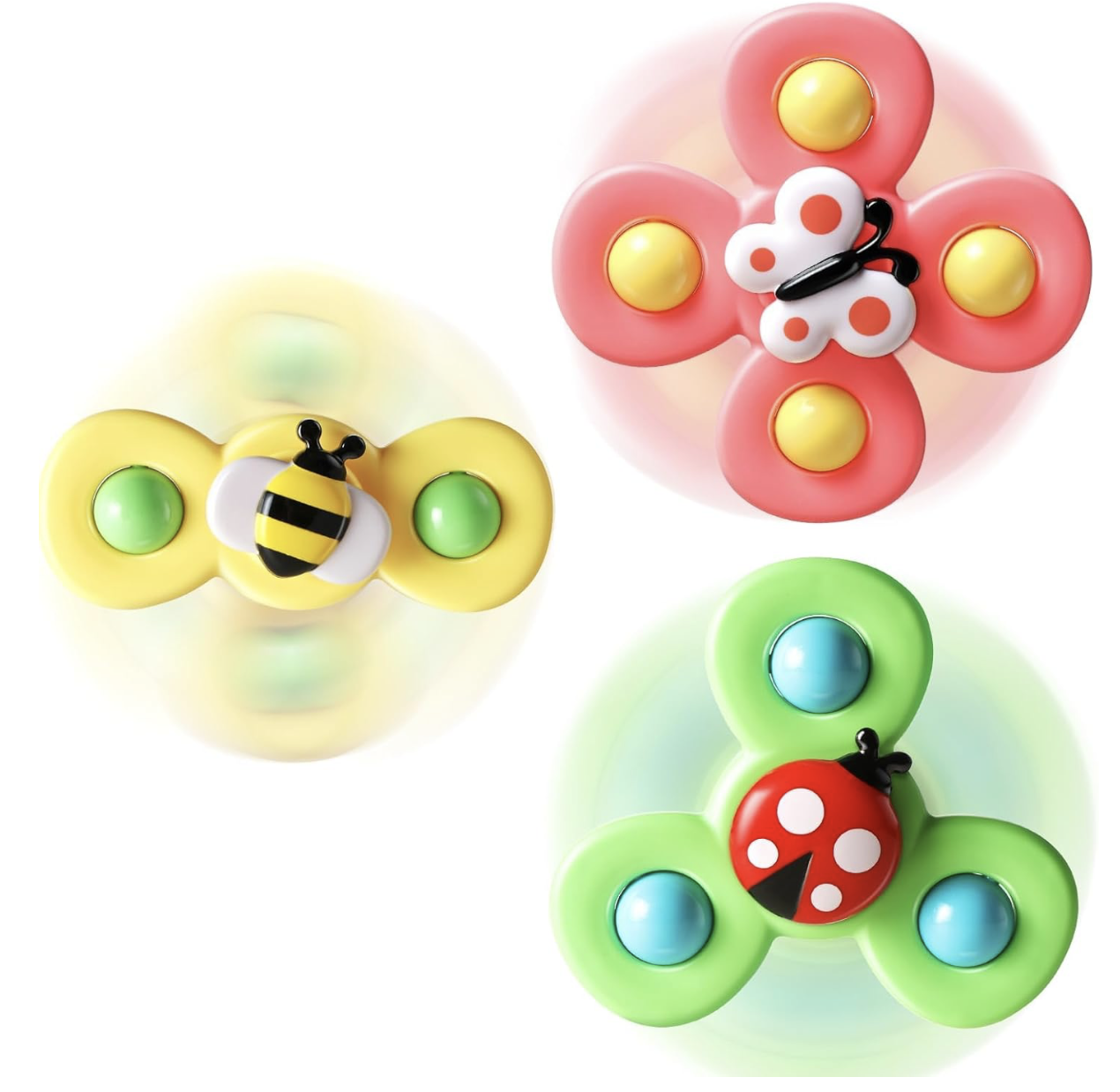
Why We Recommend This Toy
Suction cup spinners are a simple but highly engaging toy that supports visual attention, sensory regulation, fine motor development, and cause-and-effect learning. Because they can attach to windows, highchairs, bathtubs, mirrors, and tables, they create opportunities for play across positions and environments while encouraging active exploration.
What This Toy Is Useful For
This toy supports development across multiple areas:
Fine motor skills – build finger isolation, grasp strength, wrist movement, and controlled force during spinning
Early language & speech development – creates opportunities to model action words, colors, counting, and descriptive vocabulary
Cognitive skills – counting, colors, cause-and-effect
Bilateral Coordination – encourages one hand to stabilize while the other activates the toy
Independent Play & Engagement – works well for short periods of focused play at home, in restaurants, during bath time, and while traveling.
How to Use This Toy by Age
-
At this stage, babies are learning to reach intentionally, activate objects, and understand simple cause-and-effect.
Ideas to try:
Attach the spinner vertically during tummy time to encourage reaching and visual attention.
Place one spinner on a highchair tray and demonstrate pushing it.
Spin slowly and wait for your child to watch and anticipate movement.
Encourage touching the moving spinner with an open hand.
Practice reaching across midline by placing the spinner slightly to one side.
Use descriptive language like “spin,” “fast,” “stop,” and color names.
Alternate between watching and activating the toy.
Introduce turn-taking (“my turn, your turn”).
Young infants are developing visual tracking, reaching accuracy, hand opening, cause-and-effect understanding, and beginning intentional interaction with objects.
-
Children begin activating toys more intentionally and experimenting with force and movement.
Ideas to try:
Encourage your child to spin independently.
Compare fast versus slow spins.
Place multiple spinners and let your child choose which to activate.
Create simple “ready, set, go” games.
Practice stopping and starting the spinner.
Count how many turns happen before it stops.
Attach to different surfaces (mirror, window, tub) for varied positioning.
Encourage using one finger rather than the whole hand.
Children this age are strengthening finger control, motor planning, attention, and learning that they can change outcomes through their actions.
-
Children can begin using the toy with more rules, imagination, and challenge.
Ideas to try:
Create races (“Which spinner stops first?”).
Match colors before spinning.
Practice turn-taking with siblings or caregivers.
Make prediction games (“Which one will go fastest?”).
Introduce counting and timing concepts.
Create pretend play (flowers, bugs, wheels, airplanes).
Follow multi-step directions (“Spin green then touch yellow”).
Create obstacle or movement games between spins.
Older toddlers are developing sustained attention, flexible thinking, simple prediction skills, self-regulation, and more precise motor control while beginning to combine movement with language and play ideas.