Wooden Ball Drop
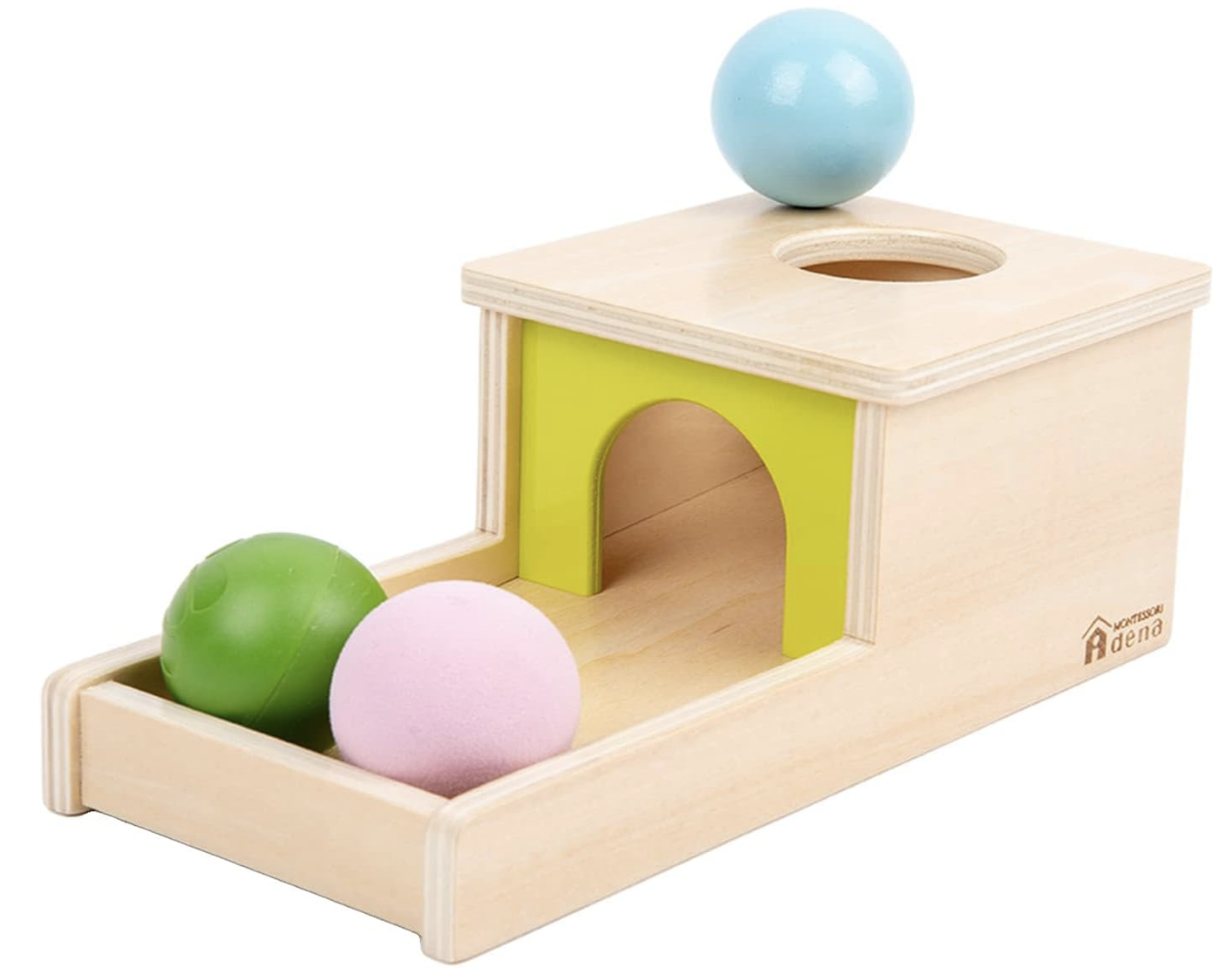
Why We Recommend This Toy
This object permanence box is a classic Montessori toy that supports one of the most important early cognitive milestones—understanding that objects continue to exist even when they disappear from view. It also promotes attention, problem-solving, visual tracking, and purposeful hand use while keeping play simple and developmentally focused.
What This Toy Is Useful For
This toy supports development across multiple areas:
Fine motor skills – support grasping, releasing, bilateral coordination, wrist control, and visually guided reaching while placing and retrieving the balls
Early language & speech development – creates opportunities to introduce action words (“in,” “out,” “drop,” “roll”), early concepts (inside/outside, gone/back), and practice following simple directions
Cognitive skills – build object permanence, cause-and-effect understanding, prediction skills, memory, problem-solving, and understanding sequences
Social skills – encourages shared attention, turn-taking, imitation, joint engagement, and back-and-forth interactions with caregivers
Attention & regulation – supports sustained attention, visual focus, anticipation, persistence, and repeated engagement with a predictable activity
How to Use This Toy by Age
-
At this stage, babies are beginning to understand cause-and-effect and are developing early object permanence.
Ideas to try:
Start by demonstrating dropping the ball and immediately showing where it appears.
Roll the ball down repeatedly and pause before revealing it to build anticipation.
Place the ball in your child’s hand and help guide it into the opening.
Hold the ball over the hole and encourage your child to release it.
Use simple language such as “in,” “gone,” “there it is,” and “again.”
Pause after the ball disappears and wait to see if your child looks toward the tray.
Practice reaching for the returned ball.
Alternate turns dropping the ball.
Young infants are developing visual attention, intentional release, understanding that objects continue to exist, and beginning to connect actions with outcomes.
-
Children begin to become more active problem-solvers and start to expect outcomes.
Ideas to try:
Encourage your child to place the ball independently into the opening.
Wait before retrieving the ball to see if your child searches for it.
Offer all three balls and practice taking turns.
Introduce simple choices (“green ball or pink ball?”).
Encourage crossing midline by placing balls slightly to one side.
Count each ball as it rolls out.
Practice handing the ball back and repeating the activity.
Introduce concepts like “under,” “inside,” and “come out.”
Children this age are strengthening object permanence, motor planning, anticipation, and understanding simple sequences.
-
Children begin using the toy more intentionally and can tolerate small challenges and variation.
Ideas to try:
Place all three balls nearby and encourage independent repetition.
Create simple prediction games (“Which ball goes next?”).
Hide the balls around the room and bring them back to the box.
Practice following directions (“Put the green one in”).
Introduce color identification and counting.
Build routines (“drop, watch, retrieve”).
Add pretend play (“Feed the box!”).
Ask questions like “Where did it go?” and “How did it come back?”
Young toddlers are developing memory, flexible thinking, early language, independent problem-solving, and longer periods of focused attention while strengthening foundational concepts that support later learning.